An In-Depth Guide To The Best Deodorant For Menopause

Contents
Menopause is that time in a woman’s life when her body goes through hormonal changes.
This isn’t exactly the most fun time as it can sometimes be uncomfortable, especially with the hot flashes that tend to come with it.
While every woman will go through “the change” in their own way, hot flashes can be a terrible experience.
Did you know that up to 80% of women have hot flashes during menopause? The Menopause Society says they can last an average of 7 to 10 years.
They can hit at any moment, putting you in a hot or cold sweat, even in the middle of the night.
Thankfully, there are deodorants out there that can help during this time. There are hundreds to choose from on the market, but our guide has found the best deodorant for menopause.
What is a Hot Flash?
If you’ve experienced one of these, you’ll know only too well what they are, but if you’ve yet to hit the menopause or perimenopause you might be wondering what’s in store.
A hot flash is a feeling of heat and often a red, flushed face with sweating that comes on extremely quickly, hence the word flash.
No one quite knows why they happen, but it’s thought they may have something to do with changes in circulation. A hot flash comes on when blood vessels near the skin’s surface dilate to cool which means you sweat. Your heart rate might go up and you might experience chills.
They often happen during the day, but they can happen at night, when they’re known as night sweats. This can disrupt sleep.
You might have heard the term hot flush. It’s simply the British name for the same thing.
Choosing a Deodorant for Menopause
There are two elements needed for the best deodorant during menopause: anti-perspirant and the actual deodorant.
The anti-perspirant works to reduce sweating while the deodorant fights the bacteria that cause bad odor. They’re usually collectively just referred to as deodorant.
Look for a product that has both of these features when you’re choosing a deodorant for menopause.
Types of Deodorant
Deodorants can come in different forms, such as stick form, roll-on, spray, and even powders and bars.
These can all be effective, and the right one comes down to personal preference. How well a product controls sweat depends on its active ingredient, not on whether it’s a stick or a spray.
Best Deodorant for Menopause
Degree Clinical Protection Deodorant
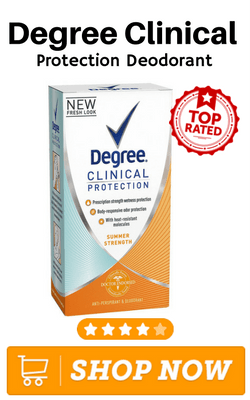
Degree Clinical Protection Deodorant is here to save the day!
Degree markets this solid stick as clinical-strength wetness protection, a step up from its regular antiperspirants.
To apply, you only need to put on a small amount under each arm. Degree says it protects for up to 48 hours.
You can turn the dial to two clicks and apply before bed.
The American Academy of Dermatology advises applying antiperspirant at night to completely dry skin and letting it dry before bed. Applying it to dry skin also lowers the chance of irritation.
If you put it on right after a shower, your skin may still be too damp for it to work well.
The scent is called “summer strength”, a combination of favorite fresh scents like green apple, jasmine, and freesia. Users have said that the scent isn’t very strong, but this can be something that people prefer.
Others have said it’s strong, but tends to disappear quickly. Either way, at least the deodorant is working to ward off the bacteria that makes you smell bad.
Reviewers have also suggested that it won’t keep you totally dry, but that’s okay as you still aren’t left with dreaded pit stains.
Another wonderful thing about Degree Clinical Protection is that one stick can last quite a long time. The specific instructions on only two clicks save a lot of people from overdoing it.
Pros & Cons
If you have kidney disease, the label tells you to ask your doctor before using it, as with other antiperspirants sold in the U.S.
This antiperspirant can help with underarm wetness from night sweats.
Degree Clinical Strength is a creamy, even slightly powdery substance. While it works great at keeping you feeling fresh, unfortunately there can be white marks on your clothes!
There are some complaints that it “doesn’t work”, but often people aren’t applying it right.
They put it on in the morning, after a shower, and as we have already discovered, it takes time to build the protective layers, which is why the directions suggest to put it on at night.
Finally, it costs more than regular deodorant – sometimes a lot more. But that’s due to its clinical strength.
Also, it lasts a lot longer than other deodorants because you only need a little bit, and it will last for up to 48 hours.
Ways to Minimise Hot Flashes
There’s no way to prevent hot flashes during menopause entirely, but you can manage them. If they disrupt your sleep or daily life, talk with your doctor. Hormone therapy and some nonhormone prescription drugs are FDA-approved to treat them.
However, there are some things that are thought to trigger hot flashes, making them more frequent or severe. They include:
- Stress
- Caffeine
- Alcohol
- Tight clothing
- Cigarette smoke
- Heat
- Spicy foods
The effect that these triggers have will vary from person to person, so be sure to monitor your hot flashes so you can identify what’s true for you.
Conclusion
Don’t let menopause get you down, ladies. Degree Clinical Protection Deodorant will keep you feeling and smelling fresh, even through the worst of hot flashes.
Not only will it help give you confidence during the day, but it will also keep you protected at night. A deodorant handles sweat and odor, while your doctor can help with the hot flashes themselves.
Keep your underarms protected with the best deodorant for menopause, Degree Clinical Protection.
Sources
- Hot Flashes, The Menopause Society
- Hyperhidrosis: Diagnosis and treatment, American Academy of Dermatology