Game, Set And Match: Find The Best Tennis Elbow Brace

Contents
Are you tired of the nagging pain of tennis elbow and wondering whether a brace can help?
Although tennis elbow doesn’t sound that bad, it’s a painful condition caused by repetitive overuse of the forearm muscles, which can lead to tiny tears in the tendon on the outside of the elbow.
If you’re a tennis player, the repetitiveness of actions causes the muscles and tendons to become tender and sore.
But you don’t have to play tennis to get tennis elbow, also known as lateral epicondylitis. Painters, plumbers, carpenters, cooks and butchers are also prone to it, and most people who get it are between 30 and 50.
It’s common, though claims that up to one in every three people have it at any one time likely overstate how widespread it is.
In this review I’ll be talking about the best brace for tennis elbow.
I’ll also look at what buyers say about E’Fit’s elbow brace.
What Makes for a Good Elbow Brace for Tennis Elbow?
First and foremost, a tennis elbow brace should ease strain on the sore tendon. The American Academy of Orthopaedic Surgeons says a counterforce brace worn on the forearm may relieve symptoms by resting the muscles and tendons.
A good tennis elbow support gives you support and pain relief so you can get on with daily activities more comfortably.
Look for an adequately padded elbow brace that protects irritated or swollen tendons from further strain.
Adjustable straps make for the perfect fit, as no two forearms are the same size.
Ensuring that the brace stays in place all day is an important thing to consider. You don’t want to have be fiddling with your brace all day. That’s just irritating.
A flexible and breathable material is a great choice for your brace for tennis elbow.
Many athletes with tendon pain wear an arm brace while they play.
Versatility is another factor that featured heavily in some tennis elbow brace reviews.
Various people use a brace for golf, volleyball, tennis, baseball, and even elbow pain from extended computer mouse use.
The best tennis elbow brace should be multifunctional, while being stylish enough to be worn every day.
One of the most important points that I can make regarding a quality tennis elbow brace is that it must be comfortable.
Now you know what to look for in a tennis elbow support, here’s my top pick.
Elbow Braces With Compression Pad By E’Fit
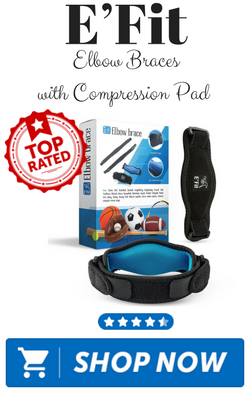
E’Fit’s Elbow Brace with Compression Pad is an effective tool for pain relief.
It’s designed to support the forearm and ease strain on the elbow.
People wear it for epicondylitis and other overuse elbow pain. A brace supports recovery but does not heal the tendon on its own.
Its adjustable Velcro strap lets you fine-tune the fit, and it’s sized for both men and women.
The compression pad focuses pressure on the forearm muscles below the elbow, which is how counterforce braces work, and adds padding.
It comes as a 2-pack in a unisex design, made from breathable, flexible material.
Some buyers say they wear it for lifting or for elbow pain from long hours using a computer mouse.
Features
· Counterforce support for the forearm
· 2-pack, unisex design
· Breathable, flexible material
· Wide range of uses
The Downside
Of all the elbow brace reviews that I’ve found, the only issue that seems to be worth mentioning is that some people find the brace to be “not such a perfect fit”.
Of all the things that people had to say about this brace in the best tennis elbow brace reviews, I’ve found that the positive feedback has heavily outweighed the negative.
That makes this brace a solid, affordable pick.
Conclusion
To sum up, a counterforce brace like this one is an easy, low-risk way to ease tennis elbow strain.
It has the features to look for in a tennis elbow brace on the market: a targeted pad, adjustable fit and breathable material.
A brace works best alongside rest from the activity that caused the pain. The AAOS says 80% to 95% of patients get better with nonsurgical treatment such as rest, anti-inflammatory medicine and physical therapy.
The NHS advises seeing a doctor if pain continues after at least two weeks of rest and self-care. See one sooner if you have numbness, weakness or severe pain.
Sources
- Tennis Elbow (Lateral Epicondylitis), American Academy of Orthopaedic Surgeons (OrthoInfo)
- Tennis elbow, NHS