
Definitive Guide To Buying A Pediatric Pulse Oximeter
Contents
- Top 10 Best Pediatric Pulse Oximeters
- Different Types Of Products
- Neonatal Pulse Oximeters
- Portable Pulse Oximeter
- Handheld Oximeter
- Brands
- AccuMed
- Vive Health
- Top 5 Products
- Pulse Oximeter by Concord
- Acc U Rate Pro Series CMS 500DL Oximeter
- Acc U Rate Children Oximeter
- AccuMed CMS-50DL Oximeter
- Finger Pulse Oximeter by Vive Precision
- Next 5 Best Products
- Finger Pulse Oximeter by TempIR
- Santamedical Generation 2 OLED Oximeter
- Yellow Bear Oximeter For Children
- Quest OXM-PC 60E Family Oximeter & Pediatric Probe
- OxyRate Pediatric Oximeter For Kids
- Buying Guide
- Conclusion
- Sources
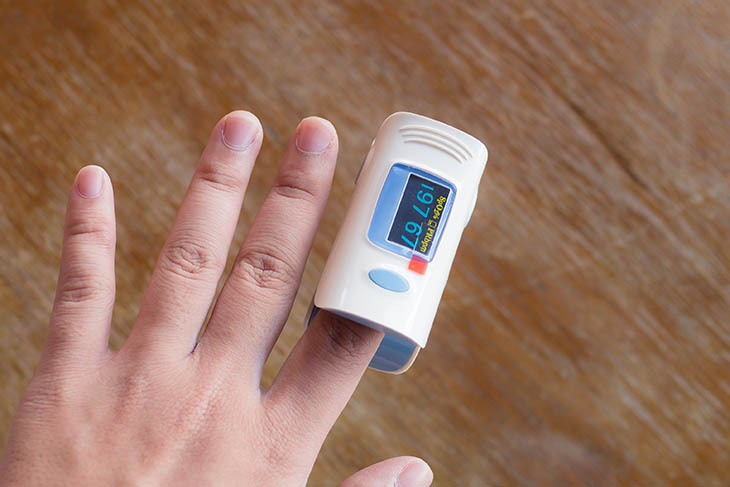
A pediatric pulse oximeter is used to measure the oxygen levels and heart rate of babies and children in a non-invasive manner.
It takes this measurement without any pain, by simple placement on the fingers or toes of children.
A home oximeter can be a useful extra check, but it can’t diagnose anything. Never use a reading to decide that a sick child is fine.
According to the FDA, many oximeters sold to consumers are marketed for sports, aviation or general wellness, and the agency doesn’t review them before they go on sale.
Readings can be thrown off by poor circulation, cold skin, skin pigmentation, skin thickness, nail polish and movement, which is common with wriggly kids.
Call your child’s doctor or 911 for trouble breathing, bluish lips, face or nails, unusual sleepiness or a racing pulse, whatever the oximeter says.
With that in mind, here’s what to know when choosing a pediatric pulse oximeter.
Top 10 Best Pediatric Pulse Oximeters
Different Types Of Products
An important note to make on these devices is that not all of them are the same.
Just like any other product you would go to buy, there are many different types of oximeter to choose from.
It’s also important to remember that while some of these models are clearly preferred, they aren’t necessarily better than one another.
They’re important to know about, however, to know which types are best for the things you’re intending to use them for.
Neonatal Pulse Oximeters
The definition of neonatal refers to newborns, usually up to one month after birth.
Before newborns leave the hospital, staff use pulse oximetry to screen for critical congenital heart defects.
The probes used are much smaller than adult sensors and usually wrap around a baby’s hand or foot.
The CDC says this screening is done when a baby is at least 24 hours old, or as late as possible if the baby goes home sooner. It’s a hospital test, not something a fingertip home device replaces.
Portable Pulse Oximeter

This type of oximeter has the digital interface on the device. This makes it simple to take a reading quickly and easily.
Most clip onto a fingertip, much like a small clothespin, and they’re easy to use.
However, they can give wrong readings if the finger is cold, circulation is poor, the child moves, or the finger is too small for the clip.
Handheld Oximeter
This is the type of oximeter that you’re more likely to find in an ER or hospital. Instead of the display being on the clip of the oximeter, it’s on a box connected to the clip by a cable.
This type of oximeter shows more than just the oxygen and heart rate, however, the exact other readings may change from model to model.
This is because this type of oximeter is meant to be used by doctors to help make a full diagnosis rather than just test for a symptom.
Brands
Brands are another important thing to look out for. Well-known brands help us choose companies and products we can trust that will stand the test of time.
In this section, we’ll take a look at some of the best brands on the market right now.
AccuMed
AccuMed is a consumer health brand that sells engineering medical products such as fingertip pulse oximeters.
Check whether a specific model is FDA-cleared for medical use or sold for sports and wellness only.
Vive Health
Vive Health, or simply Vive, is an online home health brand.
It sells a range of everyday health products, including fingertip oximeters, at consumer prices.
Top 5 Products
This section is all about finding the best pulse oximeter.
These 5 products were well rated by users when we reviewed them. Models change often, so check current specs, FDA status and age range before you buy.
This list focuses on smaller, more personal and family options rather than hospital grade models.
Pulse Oximeter by Concord
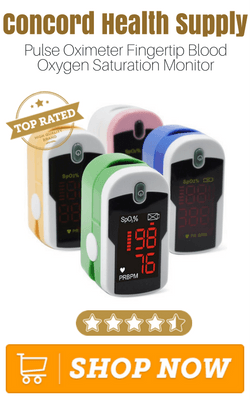
Our first paediatric pulse oximeter comes in a variety of colors including green, pink, blue, and yellow with large digital displays right on the front.
It’s made to be used on a finger and shuts off automatically after it’s removed to save battery.
It runs on 2 AAA batteries and has a low-battery indicator. Check the current warranty terms.
Acc U Rate Pro Series CMS 500DL Oximeter
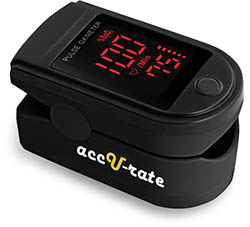
This oximeter is made for sport and health enthusiasts rather than medical professionals.
It’s the perfect size for older children.
Unfortunately, the size of it is too large for very young children, leading to inaccurate readings.
The digital display on the oximeter is also large and easy to read.
It gives a reading within seconds. Like any fingertip oximeter, it can still be off, so take readings while your child is warm and still.
Acc U Rate Children Oximeter
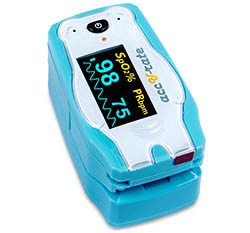
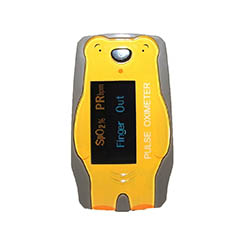
This children’s oximeter is small enough to take children’s measurements and in the fun shape of a polar bear.
It’s specifically designed to fit children’s fingers from the age of two and up.
This model also shows a plethysmograph, a pulse waveform.
It doesn’t measure blood pressure. A steady, even wave suggests a good signal, while a messy one means the reading may not be reliable.
The OLED, rotatable display also makes it easy to read.
It also comes with a free pouch and lanyard to make it easier to carry and store, as well as 2 AAA batteries so you can use your new purchase immediately.
AccuMed CMS-50DL Oximeter
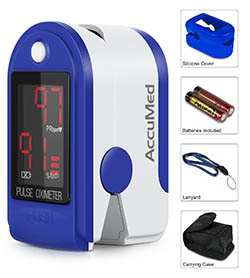
This oximeter is unique since it can fit both children and their parents.
It’s marketed for sport and exercise use rather than as a medical device, so treat its readings as a rough guide.
The screen of this oximeter is easy to read as well with digital display and protections against ambient light.
It also comes with batteries, a lanyard, and a carrying case which helps owners store and carry the device.
A reading only takes a few seconds. Check the current warranty terms.
Finger Pulse Oximeter by Vive Precision
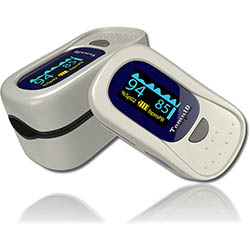
This product may be one of the easiest oximeters to use.
All you have to do to activate is turn it on and put it on your child’s finger and within seconds you’ll have their pulse rate and Sp02 displayed.
If you’re new to using these, don’t worry.
The listing describes an alarm for low oxygen or pulse readings outside a set range. A home device can’t reliably detect heart rhythm problems.
It’s also ready to go as soon as you get it thanks to batteries being included along with a carrying case, a lanyard, and an instruction manual complete with illustrations.
Check the current warranty terms.
Next 5 Best Products
Just because products are the best or highest rated, doesn’t necessarily mean that they’re the products you’re looking for.
To help you out, and in the interest of making you the most complete guide possible, here are the next 5 best oximeters so you can have exactly what you need.
Finger Pulse Oximeter by TempIR
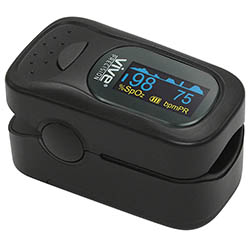
Santamedical Generation 2 OLED Oximeter
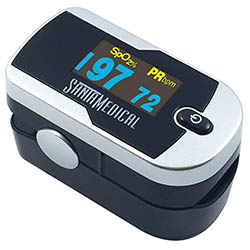
Yellow Bear Oximeter For Children
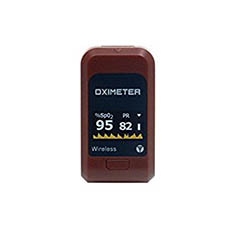
Quest OXM-PC 60E Family Oximeter & Pediatric Probe
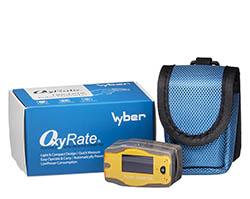
OxyRate Pediatric Oximeter For Kids
Buying Guide
We’ve looked over everything you need to know to find the best paediatric pulse oximeter, so let’s take one last look and tie it all together.
First, we looked at the types of pulse oximeters there are on the market.
There are three main ones; neonatal oximeters, handheld oximeters, and portable oximeters.
Portable models are mostly what we have looked at, since they’re easy to use, widely rated, and convenient for everyday use.
The next thing we looked at was brands, including AccuMed and Vive Health. Whatever the brand, check whether the model is FDA-cleared for medical use and sized for your child’s fingers.
Then we looked at top ten rated products with an in-depth look at the top five.
Conclusion
Taking care of your children’s health can be stressful enough without having to worry about buying the right products.
A pediatric pulse oximeter that fits well can be a handy extra check at home.
Use it alongside, not instead of, your own eyes and your child’s doctor. If your child seems unwell or is struggling to breathe, get medical help right away, whatever the reading.
If your child has a lung or heart condition, ask their doctor which device to use and what readings should prompt a call.
Sources
- Pulse Oximeter Basics, U.S. Food and Drug Administration
- Screening for Critical Congenital Heart Defects, Centers for Disease Control and Prevention