
The Ultimate Guide To High Performance Air Filters
Contents
Air filters are used to help keep the air in your home clean and safe from allergens, airborne germs, and more.
This might come as a surprise to you. EPA studies found levels of about a dozen common organic pollutants to be two to five times higher inside homes than outside, according to EPA’s indoor air guide.
Filters vary a lot in how well they work. Look at the MERV rating, an industry-standard scale; MPR and FPR are store-brand scales.
The EPA suggests MERV 13 or the highest rating your system can handle. Most furnaces can use MERV 13 if you change it often, but an HVAC technician can confirm what yours supports.
HVAC filters trap particles, not gases, and only work while the system runs. They support, but don’t replace, ventilation and removing pollution sources.
Finding the right air filter on your own can be a tricky time full of trial and error. Lucky for you, we have all the research done.
We’ve picked five high performance air filters to consider. Sizes and specs change, so confirm the fit and rating before you buy.
Filtrete Clean Living Basic Dust Filter
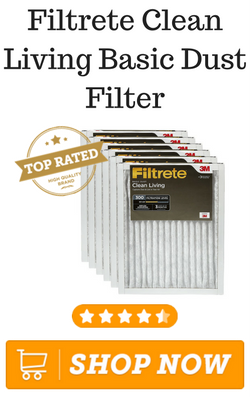
If you’re looking for a filter for your whole home, this is a good product to look at.
This comes in almost any size you could need, so no matter which your home needs, this will fulfill its requirements.
It has an entry-level MPR (Microparticle Performance Rating, 3M’s own scale), so it’s aimed at larger particles rather than fine ones.
This filter is made up of electrostatically charged fibers, allowing it to attract and capture larger allergens in the air such as pollen, dust, and lint.
The maker rates it for up to three months. Replace it sooner if it looks dirty, since clogged filters work poorly.
At three months each, a pack of 6 covers up to a year and a half.
Filtrete Healthy Living Elite Allergen Reduction Filter
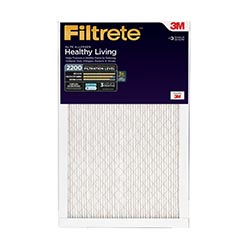
This is another filter by the same brand, with a higher rating.
This one also comes in a number of sizes, although there are admittedly fewer sizes available.
The range of the sizes of this product are between the smallest at 14-in by 20-in by 1-in and the largest at 20-in by 30-in by 1-in.
It carries a 2200 MPR. 3M says it captures most large particles such as dust, pollen and mold spores, and many smaller ones such as pet dander and smoke particles.
No furnace filter removes all pollutants, and standard pleated filters don’t remove gases. A filter also won’t fix a mold problem, which needs the moisture source fixed.
Honeywell FC100A1029 Media Air Filter
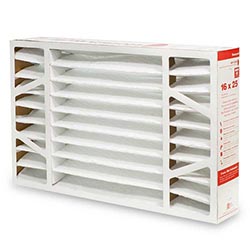
If your home has a Honeywell media air cleaner cabinet on the furnace, it uses a thicker replacement media filter like this one.
It fits specific Honeywell units, so check your model number before ordering.
Honeywell says it captures particles from 0.3 to 10 microns.
That range covers pollen, pet dander, dust and some of the fine particles that can carry germs.
6 Stage Electrostatic Washable Permanent Home Air Filter
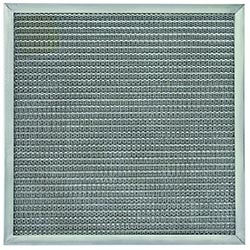
This permanent air filter is perfect for anyone who’s looking to invest in an air filter that doesn’t need to be replaced every few months.
Rather, it can be washed and reused when you’d usually get a new filter, saving you time and money.
It’s also an electrostatic filter, so it attracts particles to filter, rather than just working with what happens to go through it.
It’s heavy duty and built to last.
Washable filters often carry lower efficiency ratings than high-MERV disposable filters, so check its rating if allergies are your main concern. Let it dry fully after washing so it doesn’t grow mold.
True Blue 312301.4 Air Filter
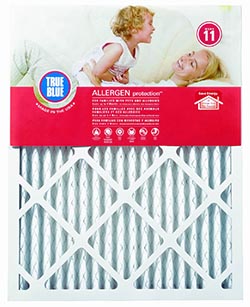
This filter is designed to trap common airborne allergens like dust, pollen, pet dander and dust mite debris, plus some smoke particles.
This will last up to 120 days, more practically calculated as 4 months, before it needs to be replaced.
It has a MERV (Minimum Efficiency Reporting Value) of 11, a solid mid-range rating.
Conclusion
A better filter is an easy upgrade for many homes.
Pick the highest rating your system can handle, change it on schedule, and pair it with good ventilation. If you have asthma or allergies, ask your doctor what else may help.
Sources
- Guide to Air Cleaners in the Home, U.S. Environmental Protection Agency
- The Inside Story: A Guide to Indoor Air Quality, U.S. Environmental Protection Agency