Your Guide To Safe Deodorant For Child Use

When we think of having to buy deodorant for our kids, we usually think we won’t have to do it until the dreaded puberty kicks in.
However, as any soccer mom or cheer dad can tell you, even a younger child can work up an impressive sweat when they run around in the heat all day.
What’s more, some children need a safe deodorant for 8-year-olds as body odor starts with early puberty changes.
If underarm odor or hair shows up before age 8 in girls or 9 in boys, mention it to your pediatrician. It is often harmless, but a doctor should check for early puberty.
But can your child use the same deodorant you do?
If they can’t, what can they use?
In this guide, we’ll do more than just drone on about different products. We’ll help you to understand how to find these products on your own and tell you what you should be looking for.
We’re going to break this problem down so you can find the best antiperspirant for kids possible.
Criteria
So, what’s really the difference between the use of a deodorant for children and deodorant for a teenager or adult?
Less than you might think. Deodorants mask or reduce odor, while antiperspirants use aluminum compounds to reduce sweat.
You may read worries about products with aluminum in them. The National Cancer Institute says there is no clear evidence that aluminum antiperspirants raise breast cancer risk.
The American Academy of Pediatrics says deodorants are helpful for controlling body odor and are safe. Many parents still prefer a gentle, fragrance-free deodorant for young skin.
Some families choose an organic or natural deodorant. “Natural” doesn’t automatically mean gentler, though: baking soda, a common ingredient, can irritate sensitive skin.
If your child gets a rash, stop the product and try a different one.
We’re going to take a look at our choice of the best organic deodorant for your child.
However, if you choose to purchase a different product, a quick glance at the ingredient list is the best way to decide if it’s right for you.
Organic Island Deodorant
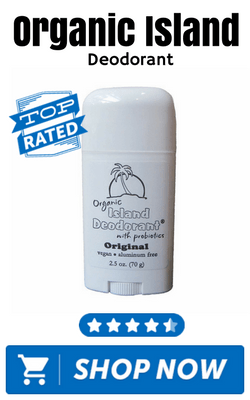
When looking for the best deodorant for children, we found Organic Island Deodorant to be the best choice.
The ingredient list for this deodorant includes coconut oil, corn starch, baking soda, wild crafted Candelilla wax, Jojoba oil, and a variety of probiotics.
It doesn’t contain aluminum, so it reduces odor but won’t stop sweat.
The maker says it leaves parabens, alcohol, gluten and BPA out of the formula.
The Organic Island Deodorant is also fragrance free.
Don’t panic, though!
We know it sounds a little illogical to make something that is supposed to block odor without giving that product a scent of its own.
The maker says ingredients like baking soda and probiotics help control odor without added fragrance.
Pros & Cons
Before we get to any negative points, let’s consider all the good that this product can bring.
It skips aluminum, parabens and fragrance, which many parents want.
Many users say a swipe or two controls odor for most of the day, though results vary.
Unfortunately, no product is perfect, so let’s take a look at the drawbacks here.
The first is the price. Being completely organic and vegan, you should expect this deodorant to run to more than your average drug store brand.
There’s a con that we should discuss that isn’t exclusive to this product but can be said about almost any all-natural deodorant.
If your child switches from an antiperspirant, they will sweat more, because a deodorant doesn’t block sweat.
There’s no “detox” involved; it just takes some time to find a product that controls odor well for your child.
Conclusion
Finding a safe deodorant for a child can be stressful if you’re going in blind.
With this guide, you know the difference between deodorant and antiperspirant and what to check on the label.
If your child sweats heavily, has a strong odor at a young age or develops a rash, check with your pediatrician.
With this information, you can have both peace of mind and hopefully a slightly more fragrant home!
Sources
- Antiperspirants/Deodorants and Breast Cancer, National Cancer Institute
- Premature Adrenarche: Information for Parents, HealthyChildren.org (American Academy of Pediatrics)