
The Best Multi-Strain Probiotic: Complete Review Guide

Contents
Not every probiotic contains the same ingredients. If you’re specifically looking for a multi-strain probiotic, we take a look at one of them here.
Many of us believe that bacteria are simply harmful organisms whose sole purpose is to spread disease and cause destruction.
There are, however, some “good” and “helpful” bacteria living in your gut which are vital to maintaining your health. Probiotic supplements aim to add helpful microbes, though research on who benefits, and from which strains, is still limited.
Did you know that the word ‘probiotic’ comes from Latin and Greek roots and means “for life”? Good bacteria are vital for human life to thrive.
A multi-strain probiotic is one which contains a variety of different bacteria. Some people assume that makes it more effective, but research hasn’t shown that multi-strain products work better in general.
Effects depend on the specific strain and the health problem it was tested for.
What Makes A Good Multi-Strain Probiotic?
When you’re looking for a great multi-strain probiotic, you should consider the following:
It’s important to look at how many different strains they contain as well as which specific types these are.
Look for strains that have been studied for the goal you have in mind.
The methods of evaluating probiotics are controversial and many still believe these products can be judged by the number of colony-forming units (CFUs).
Many experts agree that picking strains with evidence for your goal matters more than the CFU count when you choose a brilliant probiotic.
The reason is that different strains behave differently.
For example, NCCIH reports moderate-quality evidence that probiotics may lower the risk of diarrhea linked to antibiotics. Results for one strain or product don’t prove that another one works.
That’s why a long strain list alone doesn’t guarantee results.
The number of colony-forming units (CFUs) tells you how many live microbes a dose contains. Higher isn’t automatically better; the useful dose depends on the strain.
Storage
The way in which the probiotic is stored and delivered is also very important.
Bacterias are alive. They’re living organisms and need to stay that way in order to perform their functions. The container they are kept in needs to keep these organisms alive throughout distribution and on store shelves.
You should look for an offer with a sealed, opaque bottle or container which keeps light, heat, and moisture out and therefore ensures the bacteria survive.
The actual probiotic delivery system is also important. This is the way in which the bacteria actually get to your gut.
Probiotics may come in pill, capsule or pearl form. It’s vital that the casing around the bacteria can protect them from your stomach acid. A very popular way of doing this is by using time-controlled or time-released capsules and pearls.
This ensures that the capsule wall maintains its integrity for a predetermined time, allowing all the bacteria to bypass the stomach safely, before being released into the intestine.
Expiration dates are also important when comparing multi-strain probiotics. Look for a label that lists the CFU count through the end of shelf life, not just at manufacture.
Dead bacteria won’t do anyone any good.
Also keep in mind that probiotics sold as dietary supplements don’t need FDA approval before they are sold, so quality varies.
Bio-Kult Advanced Probiotic Multi-Strain Formula
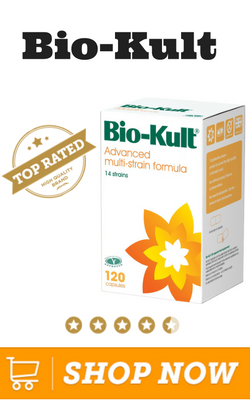
Bio-Kult is an advanced multi strain probiotic. It’s gluten-free and contains 14 different strains.
The maker says it is suitable for both adults and children. Check with a pediatrician before giving any probiotic to a child.
This supplement includes 120 capsules as standard, however, you can also select a version with 60 or 180 capsules.
Pros And Cons
Let’s see how this product stacks up against our criteria. First off, it contains multiple different strains. The maker lists strains including L. acidophilus, B. longum, B. bifidum and L. rhamnosus, plus 10 others.
In terms of CFUs, each capsule contains two billion microorganisms. This is high, but not as high as some competing products.
Some competing products list far higher counts, but as we discussed, a bigger number isn’t proof of better results.
Probiotics are generally considered safe for healthy people. People who are very ill or have weakened immune systems should talk to a doctor first, and the FDA has warned that premature infants given probiotics can develop serious infections.
The product also comes in an opaque bottle, packaged inside a cardboard box. This is good for keeping the bacteria alive and well in transport and storage.
The bacteria are freeze-dried to keep them stable in storage.
All bottles have clear expiration dates.
Wrap-up
Bio-Kult is a solid multi strain probiotic with a wide range of strains and a moderate CFU count, which makes it an easy place to start.
Whether it helps you depends on your goal. If you have ongoing gut symptoms, see a clinician for a diagnosis rather than relying on a supplement.
Sources
- Probiotics: Usefulness and Safety, NCCIH
- Probiotics: What They Are, Benefits & Side Effects, Cleveland Clinic